Sustainable research, renewable energy: Nevaeh Scott-Dominguez ’26
Energy is depleted. Machinery can’t run. Grid’s can’t sustain. It wouldn’t take much time after that for communities to find...

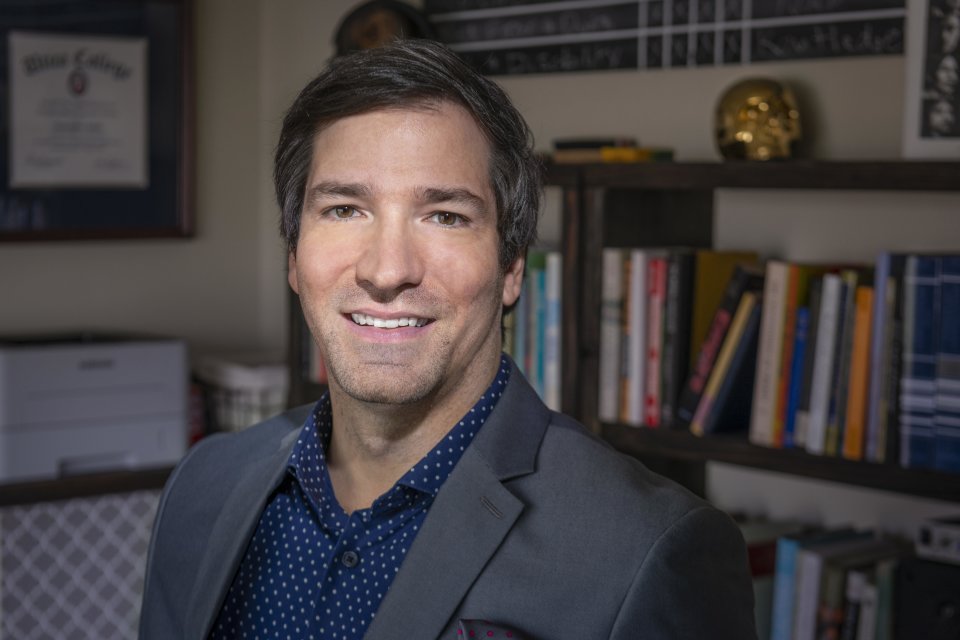
The Canadian government consults with Distinguished Professor of Philosophy Dr. Christopher Riddle in challenge to Medical Aid in Dying
Faced with a challenge to its Medical Aid in Dying (MAiD) policy, the Canadian government turned to a recognized expert for insight - Utica University Distinguished Professor of Philosophy Dr. Christopher Riddle.
“The Mentler Challenge is a constitutional challenge,” says Riddle. “It's what in Canada is called a charter challenge. It says it violates the Charter of Rights and Freedoms, but it's not just against medical aid in dying.”
Medical assistance in dying is a process that allows eligible individuals the ability to receive assistance from a medical practitioner in ending their life. The federal Criminal Code of Canada permits this to take place only under very specific circumstances and rules. Anyone requesting this service must meet specific eligibility criteria to receive medical assistance in dying, and any medical practitioner who administers an assisted death to someone must first satisfy certain requirements with regard to safeguards.
Only medical practitioners are permitted to conduct assessments and to provide medical assistance in dying. This can be a physician or a nurse practitioner, where provinces and territories allow.
MAiD became legal in Canada in 2016 for those with “reasonably foreseeable” deaths. It was expanded in 2021 to those with a “grievous and irremediable medical condition” that causes “intolerable physical or psychological suffering.”
In order to have safeguards in place, there are two separate tracks individuals follow to see MAiD through based on specific criteria of eligibility.
“Track One is for people whose reasonable death is naturally foreseeable,” Riddle explains. “Track Two eliminates that ‘natural death being reasonably foreseeable’ clause and suggests that you’re eligible if you meet every other condition but have a grievous and irremediable medical condition. So you don't have to be dying, in other words, to seek medical aid dying. [The challenge] claims that this unfairly, unconstitutionally, unjustly targets vulnerable populations, in particular people with disabilities who have grievous, irremediable medical conditions.”
The Challenge
The challenge came about after a woman with the last name Mentler visited Vancouver General Hospital in June 2023 experiencing a mental health crisis. While there, she says she was taken aback by a staffer who asked her if she had considered MAiD options. The hospital later claimed this was part of the mental health assessment to determine the severity of the case, but it has made critics of the law question whether or not it increases the risk of harm or death for people with disabilities.
A lawsuit filed by a coalition of disability activists and two people with disabilities argues that allowing people with disabilities to die via these methods violates the protections under the Canadian Charter of Rights, possibly inducing them to end their lives prematurely solely based upon their disability.
In response to the challenge, the Governor General of Canada (the federal representative of King Charles III) assembled a legal team, and that's when they reached out to Riddle.
“It was funny, because they didn't even know that I was Canadian,” he laughs. “I thought that part of the reason that they contacted me was knowing that I was Canadian, but they called it an information-finding session. This is something where a judge has to respond and the Governor General has to make a case indicating that this is not violating Sections 7 and 15 of the Charter.”
Riddle’s counterpoints to the Mentler Challenge were recently published in an article titled "Disability, Discrimination, and Assisted Dying: Opposition to Track 2 MAiD" in the Canadian Journal of Bioethics.
In it, he highlights what he views to be the principled bioethical objections present in Mentler, and assesses the veracity of the claims and logic of the arguments made by the Applicants.
The claims made by the Applicants in Mentler suggest Track 2 MAiD in Canada sanctions State-motivated murder and wrongfully increases the risk of harm or death for people with disabilities. They also suggest that expressivist harm is introduced into the lives of people with disabilities through the removal of the eligibility criterion requiring that natural death has become reasonably foreseeable, and that trust in the medical profession is also eroded. Perhaps more pointedly, they claim that Bill C-7 results in the ignoring of unjust social conditions, demonstrating a preference for people with disabilities to hasten their own death, rather than to receive suitable support.
Finally, the Applicants claim that Track 2 MAiD represents a systematic attempt to rid the world of people with disabilities – a modern form of eugenics.
Assessing the claims
In making assessments about the veracity of these claims, Riddle seeks to offer an argument about the extent to which withdrawal, caution, or advancement of MAiD policies, is warranted. While some concerns expressed in Mentler warrant attention and involve very real assessments about the ways in which society treats people with disabilities unjustly, he concludes that most of the predictions, cautions, or claims offered are either untrue or highly unlikely to ever be true.
“I think something that's really important, by way of distinction, is that this is not something that someone can have a living will for,” Riddle explains. “This is not something where substitute decision making can happen. I can't say my ‘mother wouldn't want to live like this, let's engage in MAiD.’ This is only something that the patient can consent to in the moment, which a lot of people have a problem with, because advanced degenerative illnesses, for example, part of the reason why there's this Track Two, is you're not terminal until you're beyond the ability to consent to care.”
Part of the challenge, he says, is cases where someone may be aware of an illness years down the road but by the time they reach the benchmark of six months or less left to live, no longer have the cognitive capacity to consent, which they must do both in written and verbal requests, along with confirmation of conditions by two or more physicians.
“People wrongly think that the most cited reason for seeking medical aid in dying is suffering. It's not. It's loss of autonomy.”
Some legal systems, such as over the border into America and New York State, require a mandatory psychological evaluation.
“Back in Canada, with the Track Two MAiD, there's an additional waiting period, because, of course, in Track One, where someone's dying, time can be of the essence. In Track Two, where it's just a grievous and irremediable medical condition, they can slow things down a tiny bit more. There are a whole bunch of safeguards and touch points for people to back out.”
And some do back out. Riddle says that there is much documentation indicating that many who receive the prescription medication for assistance in dying choose not to use it after all.
“The wisdom is that people want control, and if they have that medication, they can delay things a little bit longer. They can be stronger, they can endure more, because they know if it gets so bad they can take it,” Riddle says. “But a lot of people never ended up going through, so there's also the safeguard that if you go through this long process, no one's going to hold your feet to the fire and force you to follow through.”
A good deal of what Riddle has done since has been suggesting that opposition to this from a disability rights perspective is actually demeaning and harmful to people with disabilities and not oppressive or hurtful.
“This is, in fact, the proper step forward to support and to destigmatize the abilities of people with disabilities.”
From politics to philosophy
It’s a topic close Riddle’s heart, rooted in personal loss in the early years of his academic journey.
“My father died in my early twenties and I didn't know anything about the death process,” he says. “That sort of got me thinking about how broken that system is. Then, when I was doing my PhD, one of the people on the Royal Canadian Expert Panel, before the 2015 Supreme Court of Canada decision that allowed doctor’s assistance in dying, had to provide this report to the government of Canada. He hired me as a graduate student to do some research, and that's when I started thinking – ‘Here I am, a guy who focuses on disability rights. This is what I've dedicated my professional life to, yet a lot of the voices in the disability community oppose this, and I'm like, what's up? Because I think this is good from personal experience and from principled justifications.’”
Beginning as a student of political science with an interest in political theory, he soon found political philosophers wrapping their heads around the very types of topics and questions he was seeking. He switched his undergraduate studies to philosophy, focusing on political theory, and went on to earn a master’s in disability studies, then pursued that topic even further in his PhD.
He weaves these topics together into his ethic classes, including Healthcare Ethics, fostering the ethical thinking skills required to be a caring and successful healthcare professional, including the opportunity for students to experience meetings of Mohawk Valley Health System’s Ethics Committee.
“I have in the past brought students there when confidentiality permitted it, and 90% of the cases there involve people at the end of life and decision making, so students have been directly involved there,” he explains. “In many respects, they're used to and I'm used to being the voice of authority in the room. In that room I have no authority, so it's great for them to be in that room seeing how doctors, nurses, families all interact, and seeing that interpersonal exchange that young professionals have to figure out very quickly. Professionally, I think seeing how to navigate that is really helpful, especially because our school is so healthcare focused.”

For a general list of frequently used logins, you can also visit our logins page.